Home | About | Search | Contact

Patient Care

Departments
Medical Providers
Urgent Care
Outpatient Surgery
Health Services

Services

Pharmacy
Research
Articles
Billing

Facility

Human Resources
Location
Medical Records
News & Events

Search:

Department of Podiatry

2750 Broadway, Boulder, CO 80304

303-440-3036

 THE PROFESSION OF PODIATRY


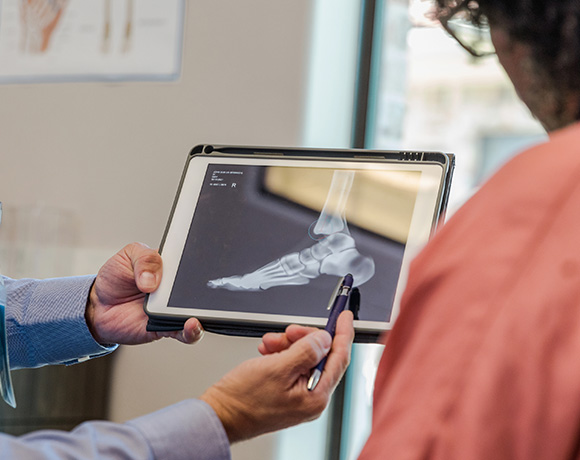
Podiatrists are defined by law as physicians and surgeons of the lower extremities.  They provide comprehensive evaluation, diagnosis, and treatment of diseases and injuries to the human foot and ankle.  Treatment may include palliative care, biomechanical modalities, physical therapy, surgical intervention, and the prescription of both systemic and topical medications.  Commonly recognized conditions include heel (plantar fasciitis), calf and arch pain as well as painful bunions, hammertoes, flat feet, ingrown/infected nails, warts and callous formation.


Over the past twenty years, podiatry has evolved from a palliative care profession to a medical and surgical specialty of the lower limb.  Due to its ongoing evolution, there is no federal legislation governing the proximal extent of the human body with which podiatry may concern itself, and so the legal definition of podiatry varies from stat to state.  In the state of Colorado, surgical intervention by qualified podiatrists is limited to any condition of the human toe, foot, ankle and/or tendons that insert into the foot.  However, non-invasive treatment of the lower limb extends proximal to just below the knee.  Indeed, many general manifestations of musculoskeletal overuse and strain are caused by a lack of stability or imbalance in the foot.  The etiology of these conditions are well understood and treated by the podiatrist who is knowledgeable in biomechanics of the lower limb.


A doctor of Podiatric Medicine (D.P.M.) has spent a minimum of four years in an undergraduate institution, and must hold a Bachelors degree before he/she is allowed to take the Medical College Admission Tests (MCAT), as do A.M.A. medical school applicants.  Contingent on undergraduate grades, board scores, and rigorous interviews, he/she is selectively chosen to enter a College of Podiatric Medicine.  Podiatric medical school entails four additional years of study, during which the student receives a general medical education comparable with that of the A.M.A. and D.O. medical schools.  The primary advantage is the podiatric student is involved in additional specialty courses dealing with lower extremity anatomy, biomechanics, podiatric medicine, sports medicine, and surgery.  Upon completion of medical school and passing a National Podiatric Medical Board Examination, he/she is required to complete a two to three year residency program.  Upon completion of the residency, the podiatrist may elect to undergo the certification process in Foot and Ankle Surgery.  This involves taking the American Board of Podiatric Surgery (ABPS) board qualifying exam in Forefoot surgery and Rearfoot and Ankle surgery.  The candidate may sit for the ABPS board certification exam only after passing the board qualifying exams and appropriate case documentation after residency. 


A Doctor of Podiatric Medicine is truly a physician uniquely qualified to treat disorders of the human foot and ankle.


Providers