
Cataract Surgery: Lens Options and What to Expect Before and After Surgery
September 23, 2026 | 7 min read

Choosing an intraocular lens, or IOL, is an important part of cataract surgery preparation. Your overall eye health, including dry eyes, corneal irregularities, previous LASIK or PRK, and macular or retinal disease, plays a role in determining which lenses may give you the best results. Your prescription and the amount of corneal astigmatism you have are also important considerations.
During your preoperative visit, we will review these factors and discuss the type of vision you want after surgery.
What Type of Vision Would You Like After Cataract Surgery?
I generally break the choices into three vision goals:
- Good distance vision — with reading glasses for near tasks
- Good reading vision — with glasses for distance
- Distance, computer and reading vision — with less dependence on glasses, although glasses may still improve vision for some activities
BMC offers several types of intraocular lenses to meet these goals.
Intraocular Lenses Available at Boulder Medical Center
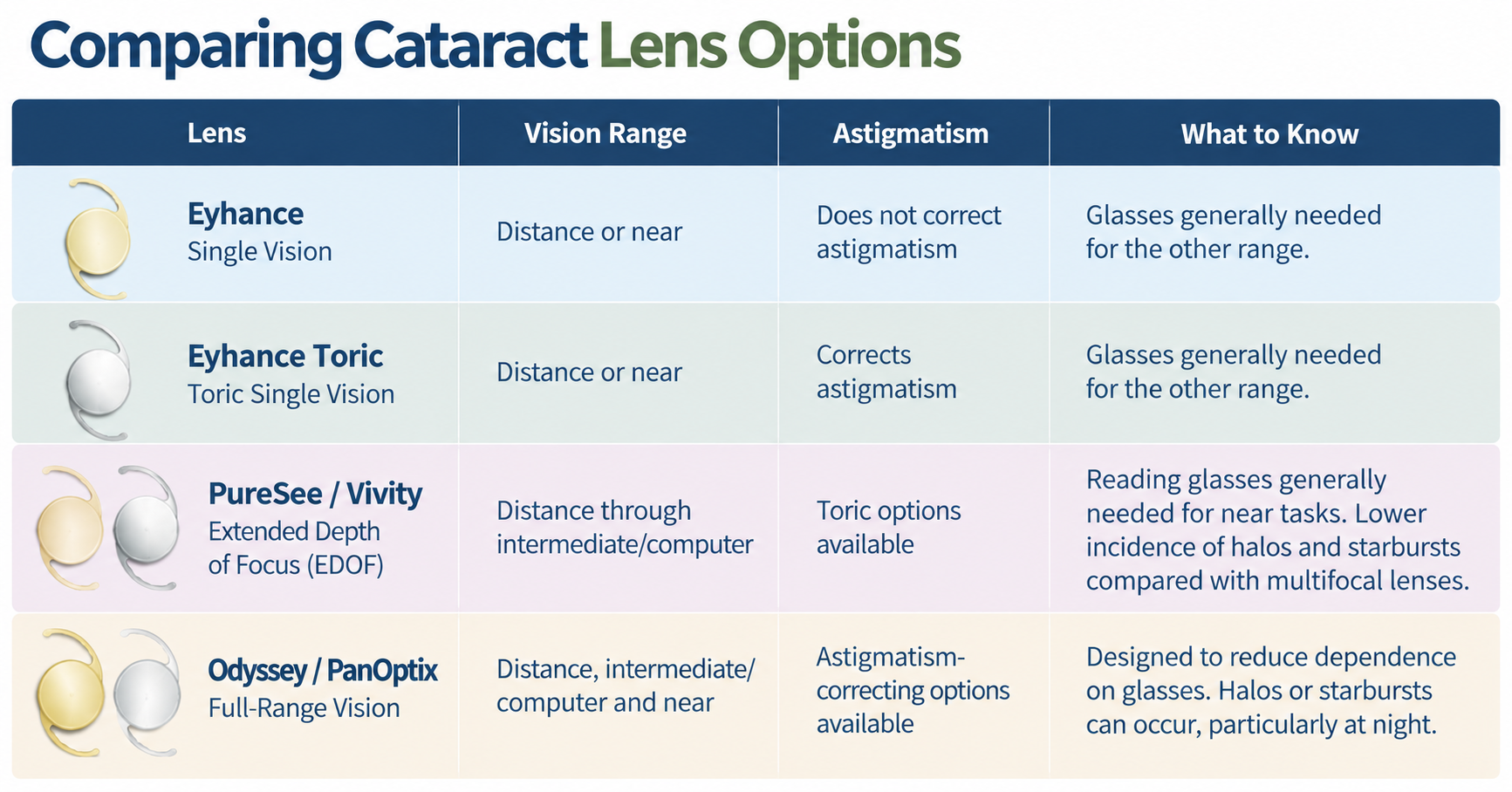
Single-Vision Lens: Eyhance
The TECNIS Eyhance single-vision lens can be calculated for either distance vision or reading vision.
If you choose distance vision, you will generally need glasses for reading. If you choose reading vision, you will generally need glasses for distance.
The standard Eyhance lens does not correct corneal astigmatism. If you have astigmatism, you may see better with bifocal or progressive glasses that correct the remaining astigmatism.
This is the conventional lens option used during cataract surgery and is generally covered by Medicare and insurance when cataract surgery is medically necessary.
Toric Single-Vision Lens: Eyhance Toric
The TECNIS Eyhance Toric lens is similar to the single-vision lens but also corrects corneal astigmatism.
If you have astigmatism, this lens can provide good vision at either distance or near, depending on how the lens is calculated. You would then generally use glasses for the other range.
Because astigmatism correction provides functionality beyond a conventional intraocular lens, this lens has an additional out-of-pocket cost.
Extended Depth-of-Focus Lenses: PureSee and Vivity
Extended depth-of-focus, or EDOF, lenses provide a broader range of vision than a single-vision lens. The EDOF options I offer include TECNIS PureSee and Alcon Vivity.
PureSee uses a purely refractive, ring-free design with Continuous Power Technology to extend vision from distance to intermediate range while aiming to maintain contrast comparable to a single-vision lens.
Vivity is a non-diffractive EDOF lens that extends focus from distance to intermediate, rather than splitting light into separate focal points for distance, intermediate, and near.
Most patients with EDOF lenses will still use reading glasses for close-up tasks. One benefit of non-diffractive EDOF technology is a lower incidence of visual disturbances such as starbursts or halos compared with multifocal IOLs.
These lenses may also be an option for some patients with mild corneal or retinal conditions. Patients with previous LASIK or PRK, mild Fuchs dystrophy, or dry eyes may still benefit from an EDOF lens. Patients with mild macular disease, such as drusen or an epiretinal membrane, can often do well with Vivity as well.
In my experience, extended depth-of-focus IOLs are ideal for patients with mild corneal or macular disease who want good distance-to-intermediate vision, don’t mind using reading glasses for near tasks, and want a lower risk of starbursts or halos.
For patients with moderate to severe ocular disease, such as multiple previous LASIK procedures, macular degeneration, or severe dry eyes, I generally recommend a single-vision lens.
EDOF lenses are also available in toric models that correct astigmatism.
Full-Range Vision Lenses: Odyssey and PanOptix
For patients who want good distance, computer, and reading vision with less dependence on glasses, I also offer TECNIS Odyssey and Alcon PanOptix.
Odyssey is an advanced IOL designed to provide a continuous range of vision from near through intermediate and distance. It uses a diffractive optical design that blends multiple focal points to provide vision at different distances while aiming to maintain good contrast and reduce glare and halos.
PanOptix is a trifocal IOL that provides three focal ranges: distance, computer, and reading vision. PanOptix was approved for use in the United States in 2019, and I have implanted this lens during cataract surgery since then.
These full-range lenses can provide:
- Vision at multiple distances, including reading, computer use, and driving
- Less dependence on glasses for many daily activities
- Astigmatism correction with available toric options
- There are trade-offs. You may experience halos or starbursts in certain lighting conditions, particularly at night. These visual effects may diminish over time.
Full-range lenses may not be the best option for patients with significant dry eye, retinal or optic nerve disease, advanced glaucoma, or other significant eye disease. They may also not be a good fit if you are particularly sensitive to nighttime glare and halos or expect never to need glasses after cataract surgery.
Medicare, Insurance and Premium Lens Options
Medicare generally covers medically necessary cataract surgery and a conventional intraocular lens. When a patient chooses an IOL with additional astigmatism- or presbyopia-correcting functionality, Medicare does not cover the additional functionality and related services beyond what it covers for a conventional IOL. Patients who choose these upgraded lens options can therefore have additional out-of-pocket costs.
Private insurance and Medicare Advantage coverage vary by plan. Patients should review their individual benefits and the costs associated with their lens choice before surgery.
Choosing Your Lens
No single lens is right for everyone. Your eye health, prescription, amount of astigmatism, previous eye procedures, and the type of vision you would like after surgery all play a role in determining which lens may be appropriate.
I recommend reviewing these options before your preoperative appointment so you are familiar with the choices available. You don’t need to decide on your own. We will discuss your options together during your preoperative visit and choose a lens based on your eyes and your vision goals.
What to Expect Before Cataract Surgery
Before your preoperative appointment, please review the intraocular lens options above so you are familiar with the types of lenses available. We will discuss the options and decide during your preoperative appointment.
You will also need to schedule an appointment with your primary care provider for surgical clearance at least two weeks before your first surgery.
Your Cataract Surgery Appointments
For patients having cataract surgery on both eyes, there are typically seven appointments associated with the process:
- Preoperative appointment
- First cataract surgery
- Postoperative appointment within 24 hours of surgery
- One-week postoperative appointment / preoperative appointment for the second eye
- Second cataract surgery
- Postoperative appointment within 24 hours of surgery
- Four-week postoperative appointment
What to Expect After Cataract Surgery
Vision typically improves within a few days after cataract surgery, but it can take time to adjust. Patients with full-range lenses may notice glare or halos early on, which often lessen over time.
Following your postoperative instructions is an important part of healing.
Day of Surgery
- Do not drive on the day of surgery.
The First Week
- Do not get water directly into the eye.
- Do not wear eye makeup.
- Do not apply sunscreen near the eyes.
- Showering is okay, but keep your eyes closed while washing your hair.
- Exercise and Travel
- Avoid upside-down positions during yoga or Pilates.
- Running and lifting weights are okay.
- Flying and traveling are okay.
- Do not swim or use a hot tub for three weeks after surgery.
After Three Weeks
- You may resume swimming and your regular activities.
Eye Drops
- Lubricating eye drops, such as Systane, Refresh, or Soothe, are fine to use anytime.
- If you normally use glaucoma eye drops, continue using them as directed.
Questions or Scheduling
I hope this guide helps simplify your cataract lens options and what to expect before and after surgery. I am happy to discuss your lens options and answer questions at your visit.
To schedule cataract surgery or an appointment with Ken Kreidl, MD, call Boulder Medical Center Ophthalmology at (303) 440-3055.