
Prescription vs. Over-the-Counter Hearing Aids: Which Is Right for You?
July 23, 2026 | 6 min read

If You’re Considering Hearing Aids, Start with a Hearing Evaluation
If you’ve noticed signs of hearing loss, the first step isn’t choosing a hearing aid; it’s having your hearing evaluated.
A comprehensive hearing evaluation by an audiologist helps determine the type and degree of hearing loss, establishes a baseline for monitoring changes over time, and can sometimes identify hearing problems that require medical evaluation.
After your evaluation, your audiologist will review the results with you and recommend the hearing solution that’s most appropriate for your hearing loss, communication needs, lifestyle, and budget. For many people, that recommendation may be a prescription hearing aid because it offers personalized programming, advanced technology, and ongoing professional care. Others may wish to consider an over-the-counter (OTC) hearing aid, particularly if they have perceived mild to moderate hearing loss or are concerned about cost.
Understanding the differences can help you make an informed decision.
In this guide, Boulder Medical Center audiologist Shawn Denham, AuD, explains the differences between prescription and OTC hearing aids, what each option offers, and why a comprehensive hearing evaluation should always come first.
Start with a Comprehensive Hearing Evaluation
Before choosing a hearing aid, it’s important to understand your hearing.
A comprehensive hearing evaluation allows your audiologist to:
- Determine the type and degree of hearing loss.
- Establish a baseline to monitor changes over time.
- Identify hearing problems that may require evaluation by an ear, nose, and throat (ENT) specialist.
- Recommend the hearing solution that’s most appropriate for your hearing, communication needs, lifestyle, and budget.
Even if you’re considering an OTC hearing aid, a hearing evaluation provides valuable information that can help you make a more informed decision. It also gives your audiologist a baseline so your hearing can be monitored over time.
Prescription Hearing Aids and Professional Hearing Care
Prescription hearing aids include much more than the device itself.
Hearing care begins with a comprehensive hearing evaluation, followed by professional fitting, individualized programming, and ongoing support from an audiologist. As your hearing changes over time, your hearing aids can be adjusted to help you continue hearing your best.
One of the greatest advantages of prescription hearing aids is the long-term relationship with your audiologist. Hearing loss often changes gradually, and regular follow-up visits allow your audiologist to monitor your hearing, fine-tune your hearing aids, answer questions, and help you get the greatest benefit from your hearing technology for years to come.
What You Receive with Prescription Hearing Aids
- A comprehensive hearing evaluation to accurately assess your hearing.
- Personalized hearing aid selection based on your hearing loss, lifestyle, communication needs, anatomy, and budget.
- Guidance from audiologists familiar with a wide range of hearing aid manufacturers, styles, and technology.
- Custom programming using validated prescriptive formulas.
- Real-ear measurements to verify that your hearing aids are providing the appropriate amplification.
- Follow-up visits for adjustments, counseling, and hearing aid optimization.
- Professional cleaning, maintenance, and troubleshooting.
- Support with connectivity, fit, comfort, feedback, and sound quality.
- Ongoing monitoring of your hearing and reprogramming as your hearing changes.
- Assistance navigating hearing aid warranties and, when applicable, insurance benefits.
Many prescription hearing aids also include advanced features such as directional microphones, sophisticated noise reduction, rechargeable batteries, Bluetooth® streaming, smartphone connectivity, and sound processing designed to improve hearing in a variety of listening environments.
What Are Over-the-Counter (OTC) Hearing Aids?
Over-the-counter hearing aids became widely available in the United States after the U.S. Food and Drug Administration established a new category in 2022. These devices are designed specifically for adults ages 18 and older with perceived mild to moderate hearing loss. They can be purchased without a prescription, hearing test, or professional fitting.
OTC hearing aids are typically available online or in retail stores and are self-fitted using smartphone apps or built-in controls.
For some adults, OTC hearing aids may provide meaningful benefit. However, it’s important to understand that they do not include the comprehensive hearing evaluation, individualized fitting, or ongoing clinical care that are part of prescription hearing care.
Advantages of OTC Hearing Aids
- Lower upfront cost than most prescription hearing aids.
- Available without an appointment or prescription.
- Convenient for people comfortable setting up and adjusting the devices independently.
- May provide benefit for some adults with perceived mild to moderate hearing loss.
Limitations of OTC Hearing Aids
- No diagnostic hearing evaluation to determine the type or degree of hearing loss.
- No personalized programming based on your individual hearing profile.
- No real-ear measurements to verify appropriate amplification.
- No professional fitting or follow-up care.
- No ongoing monitoring as your hearing changes.
- No professional cleaning, maintenance, or troubleshooting.
- Not intended for children or adults with more advanced or complex hearing loss.
Prescription vs. OTC Hearing Aids: A Side-by-Side Comparison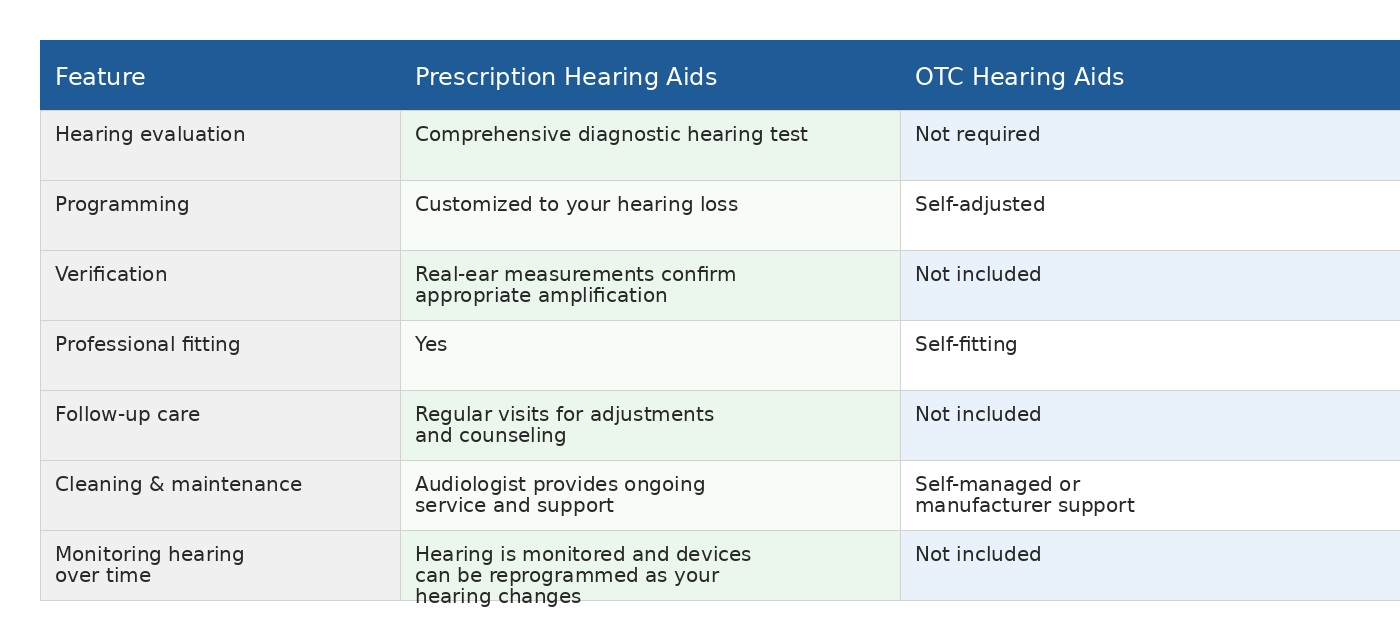
Frequently Asked Questions
Do I need a hearing test before buying OTC hearing aids?
No. Adults can purchase OTC hearing aids without a hearing test or prescription. However, a professional hearing evaluation helps determine the type and degree of hearing loss, establishes a baseline for future care, and may identify medical conditions that require additional evaluation. It also provides valuable information to help you choose the hearing solution that’s most appropriate for your needs.
Can children use OTC hearing aids?
No. OTC hearing aids are intended only for adults ages 18 and older with perceived mild to moderate hearing loss. Children with hearing concerns should receive a comprehensive hearing evaluation from a qualified hearing healthcare professional.
Are prescription hearing aids better than OTC hearing aids?
Prescription hearing aids provide individualized programming, professional fitting, real-ear verification, and ongoing care from an audiologist. While OTC hearing aids may benefit some adults with mild to moderate hearing loss, they do not include the personalized evaluation, fitting, and long-term support that accompany prescription hearing care.
How do I know which hearing aid is right for me?
The best option depends on your type and degree of hearing loss, communication needs, lifestyle, personal preferences, and budget. A comprehensive hearing evaluation is the best place to start because it helps you understand your hearing and allows your audiologist to recommend the treatment options that best meet your needs.
Let’s Talk
If you’re noticing signs of hearing loss or are considering hearing aids, the Audiology team at Boulder Medical Center is here to help.
Our audiologists provide comprehensive hearing evaluations, personalized recommendations, hearing aid fittings, and ongoing hearing care for adults and children in Boulder and Louisville, Colorado. Whether you’re exploring prescription hearing aids or want to understand your hearing better, we’re here to answer your questions and help you make an informed decision.
Learn more about BMC Audiology and schedule a hearing evaluation.