
High Blood Pressure Charts: Targets, Home Monitoring, and Treatment Guidelines
January 18, 2026 | 7 min read

High blood pressure (hypertension) is a leading cause of heart disease and stroke, often developing without noticeable symptoms. Updated guidelines from the American Heart Association and American College of Cardiology emphasize earlier diagnosis, home monitoring, and a risk-based approach to treatment. In this article, Jose Delgado, MD, explains what these changes mean and how understanding your blood pressure can help protect your long-term heart health.
Hypertension (HTN), or high blood pressure, is the leading risk factor for death and disability worldwide. It is a major cause of stroke, heart attack, kidney failure, atrial fibrillation, vascular dementia, aortic aneurysm, and other life-threatening conditions. Hypertension is common. About 2 out of 3 adults aged 55 and older have HTN.
The tricky thing about HTN is that, for most people, it is a silent condition, which is why it is nicknamed “The Silent Killer”. Hypertension can be challenging to diagnose because blood pressure can vary significantly from person to person. For instance, up to 30 percent of people have white-coat HTN, which occurs when a patient’s blood pressure is high in the doctor’s office but completely normal as soon as they walk out the door.
Identifying those who truly have high blood pressure and treating their condition with lifestyle modifications and medication is critical, as we can significantly reduce the risk of developing more severe health conditions and prolong life while we’re at it!
Measuring Blood Pressure – A History
The Joint National Committee (JNC) on Detection, Evaluation, and Treatment of High Blood Pressure published the first medical guidelines for HTN in 1977. Back then, most of the research suggested that tracking diastolic blood pressure was most important. Diastolic blood pressure measures the pressure in your blood vessels when your heart rests between beats. At that time, high blood pressure was defined as a diastolic BP (blood pressure) of 105 mmHg (millimeters of mercury—the units used to measure blood pressure) or greater.
The next major guideline, the JNC 7, was published in 2003. Better randomized and controlled trials showed the importance of measuring systolic blood pressure, the pressure in your blood vessels when your heart beats. Hence, the new JNC 7 guidelines included both systolic and diastolic levels. Hypertension was defined as 140/90 mmHg or greater (140 denotes systolic and 90 is the diastolic measurement). In addition, a new category, “Pre-HTN,” was defined as BP 130-139/80-89 mmHg. If you were in this Pre-HTN category, your doctor typically recommended lifestyle modifications and kept a closer eye on you. If you had chronic kidney disease or diabetes mellitus, your doctor would initiate more intensive treatment for BP 130/80 mmHg or greater.
An Updated View of High Blood Pressure
In 2014, the National Heart, Lung, and Blood Institute transferred sponsorship of cardiovascular disease prevention guidelines to the American Heart Association and the American College of Cardiology. These two organizations, along with nine other professional societies, worked together to develop the latest guidelines, published in 2017. This multidisciplinary team met quarterly for 3 years and did not draw on relationships or influence from industries involved in the diagnosis or treatment of HTN. As a result, the guidelines were extremely well done, objective, and extensive. Out of the 106 recommendations in the study, I will focus on four main themes in this article:

The new guidelines recommend measuring blood pressure both at home and at the doctor’s office.
- The New Blood Pressure Targets
- A Risk-Based Approach to Treatment
- The Importance of Home Blood Pressure Monitoring
- Emphasis on Lifestyle Modification
New Blood Pressure (BP) Targets
The new guidelines represent a significant change from how doctors managed patients with high blood pressure in the past. Here are the new BP targets in four categories:
- Normal — Under 120/80 mmHg
- Elevated — 120-129/under 80 mmHg
- Stage I HTN — 130-139/80-89 mmHg
- Stage II HTN — 140/90 mmHg or greater
If these numbers seem low, it is useful to know that, based on a large observational database, blood pressure begins to increase the risk of cardiovascular disease and death at a systolic pressure of 115 or higher.
A Risk-Based Approach to High Blood Pressure Treatment
Using the JNC 7 targets from 2003, about 72 million adults had HTN. The new guidelines raise that number to 102 million. However, of the new 30 million being diagnosed with HTN, only 4.2 million will actually need medication. The others fall under categories that require closer observation and lifestyle modifications.
For adults in the Stage I HTN category, we consider prescribing medication if there is clinical cardiovascular disease, chronic kidney disease, diabetes mellitus, or a 10-year risk of a cardiovascular event that is 10% or greater. To determine the risk of a cardiovascular event, we use the Atherosclerotic Cardiovascular Disease Risk Estimator, which is also used to manage high cholesterol.
If you are in the Stage II HTN category, you definitely need to be on medication that will help you obtain a target BP of under 130/80 mmHg.
Home Blood Pressure Monitoring
The new guidelines emphasize monitoring your blood pressure at home – not just in the doctor’s office. This approach allows your physician to combine the average blood pressure readings in the office and at home to confirm an HTN diagnosis. The guideline also outlines a standard method for measuring blood pressure at home. Here are a few tools from the American Heart Association and American Stroke Association that can help you measure your own blood pressure:
Tracking your readings over time is critical to understanding and managing your blood pressure. Here is a Seven-day Blood Pressure Monitoring Procedure that I recommend to my patients:
- Take two morning and two evening readings for seven consecutive days. Be sure to sit down and relax for five minutes in the morning before taking the first reading, then take the second reading one minute later. Do the same thing in the evening. After seven days, calculate the average of all of your readings.
- If you tend to have high readings in the doctor’s office due to white-coat HTN, or if you have elevated Stage I or Stage II HTN, monitor your blood pressure using this procedure for 7 days prior to an office visit.
- If your blood pressure medication changes, wait two weeks, then use this seven-day monitoring procedure to take new readings.
- Measure your blood pressure before eating, drinking coffee, taking medication, or engaging in any exercise.
High Blood Pressure and Lifestyle Modification
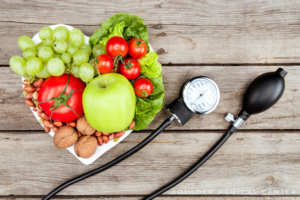
The DASH eating plan helps prevent and treat high blood pressure and can lower cholesterol.
The new guidelines also recommend lifestyle modifications to manage blood pressure. The following steps can lower blood pressure by 5 to 11 mmHg:
- Exercise — 90 to 150 minutes of aerobic and/or resistance exercise each week
- Lose weight if overweight — the target Body Mass Index (BMI) is under 25. There is about a 1 mmHg drop in blood pressure for every kilogram of weight loss
- Reduce your sodium intake — less than 1,500mg of salt per day
- Eat a heart-healthy diet — the Dietary Approaches to Stop Hypertension (DASH) eating plan can help lower or control high blood pressure. Rich in fruits, vegetables, low-fat and nonfat dairy, whole grains, lean meats, and heart-healthy fats, the plan is flexible and requires no special foods. DASH has ranked as the best overall diet for eight years in a row by U.S. News and World Report.
Learn About the DASH Eating Plan - Include more potassium-rich foods in your diet (examples: avocado, acorn squash, spinach, sweet potato, wild-caught salmon, dried apricots, pomegranate, coconut water)
- Drink alcohol in moderation. Two drinks or less for men and one drink or less for women per day.
Let’s Talk
Are you looking for a skilled and caring internal medicine doctor in Boulder? Dr. Delgado is trained in the prevention, diagnosis, and treatment of adult diseases and has treated virtually every imaginable health condition. He is accepting new patients 65 and older. Make an appointment today.